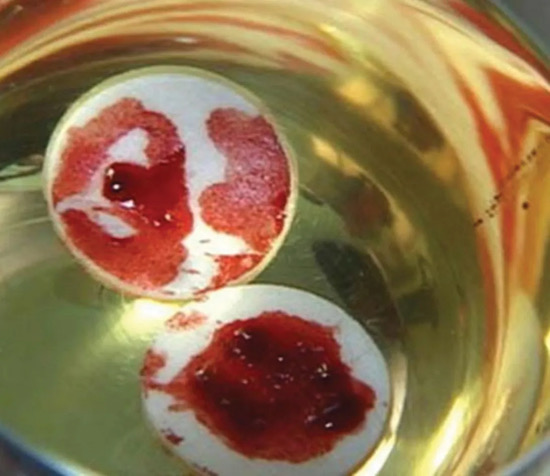
Short Summary: A misplaced Eucharist, found submerged in holy water, began to bleed and grew in size over ten days, leading to investigations that revealed it was human heart tissue with living white blood cells.
Details
Location: Buenos Aires, Argentina
Year: 1996
Prayer: Prayer to Obtain Humility by Thérèse of Lisieux: O my Beloved, under the white Eucharistic veil Thou does indeed appear to me meek and humble of heart. To teach me humility, Thou cannot further abase Thyself, and so I wish to respond to Thy Love, by putting myself in the lowest place, by sharing Thy humiliations, so that I may have part with Thee in the Kingdom of Heaven. Each morning I resolve to be humble, and in the evening I recognize that I have often been guilty of pride. The sight of these faults tempts me to discouragement; yet I know that discouragement is itself but a form of pride. I wish, therefore, O my God, to build all my trust upon Thee. As Thou can do all things, deign to implant in my soul this virtue which I desire, and to obtain it from Thy Infinite Mercy, I will often say to Thee: “Jesus, meek and humble of heart, make my heart like unto Thine. Amen.
Verse: Through him you have come to trust in God, who raised him from the dead and gave him glory, so that your faith and hope are set on God. -1 Pt 1:21
Full Story
A misplaced Eucharist was found in a church in Buenos Aires, and, according to custom, a priest placed it in a bowl of holy water to dissolve. After three days, the Eucharist appeared to be covered in blood. Over the next ten days, it continued to grow in size. Archbishop Jorge Bergoglio, who would later become Pope Francis, was asked to oversee the situation. Recognizing the potential significance of the event, Archbishop Bergoglio enlisted Ricardo Castañon, a Bolivian neuropsychologist and former atheist, to lead an investigation. Castañon enlisted a team of eight scientists from various fields to study the Eucharist. Their research revealed that the sample was human tissue, specifically cardiac tissue, with living white blood cells—a striking finding since white blood cells typically die minutes after leaving the body. This discovery deeply affected Castañon and ultimately led to his conversion to Catholicism. Further analysis was conducted by Dr. Frederick Zugibe, a renowned forensic pathologist at Columbia University and expert in heart disease. Without being told the sample's origin, Dr. Zugibe identified it as myocardium tissue from the left ventricle of the heart, noting that the person from whom it originated had experienced severe stress, as in the case of someone undergoing physical trauma. Dr. Zugibe also expressed his surprise at finding living white blood cells, which should not have been present in a sample outside the body for an extended period of time. In line with findings from other Eucharistic miracles, the blood type of the sample was determined to be AB, a rare blood type that is also known as the universal receiver. This blood type has been consistently found in other well-documented Eucharistic miracles.
Related Miracles
-
Related Miracle 1
Related Miracle 2
Related Miracle 3
Related Miracle 4
Related Miracle 5
Related Miracle 6