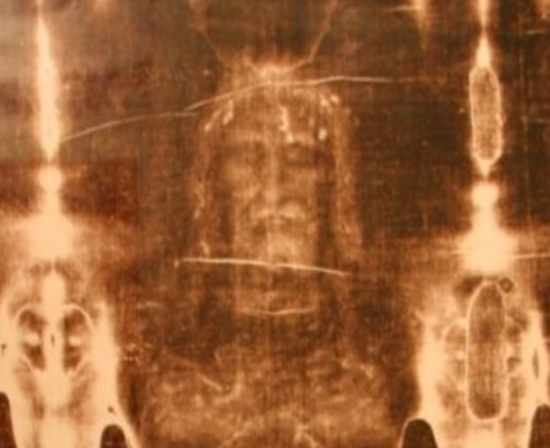
Short Summary: The Shroud of Turin, believed to be the burial cloth of Jesus, bears the faint image of a crucified man and has undergone extensive scientific analysis.
Details
Location: Jerusalem, Israel
Year: 34
Prayer: Jesus, I turn to you now in prayer, Help me to meditate on your seven last "Words" of divine power, uttered during your Passion. 1. "Father, forgive them, they know not what they do." (Forgiveness) 2. “Amen, I say to you, today you will be with me in Paradise” (Salvation) 3. “Woman, behold, your son….Behold, your mother.” (Relationship) 4. “I thirst.” (Distress) 5. “My God, my God, why have you forsaken me?” (Abandonment) 6. “It is finished.” (Triumph) 7. “Father, into your hands I commend my spirit.” (Reunion)
Verse: Now on the first day of the week Mary Magdalene came to the tomb early, while it was still dark, and saw that the stone had been taken away from the tomb. So she ran, and went to Simon Peter and the other disciple, the one whom Jesus loved, and said to them, “They have taken the Lord out of the tomb, and we do not know where they have laid him.” Peter then came out with the other disciple, and they went toward the tomb. They both ran, but the other disciple outran Peter and reached the tomb first; and stooping to look in, he saw the linen cloths lying there, but he did not go in. Then Simon Peter came, following him, and went into the tomb; he saw the linen cloths lying, and the napkin, which had been on his head, not lying with the linen cloths but rolled up in a place by itself. -Jn 20:1-7
Full Story
The Shroud of Turin, believed by many to be the burial cloth of Jesus Christ, is one of the most studied and debated relics in the world. The cloth bears the faint image of a crucified man—bearded, approximately 5'11", and showing clear signs of suffering. It is also stained with real human blood. Over the centuries, the Shroud has been the subject of numerous scientific investigations. Among the more fascinating discoveries is the presence of pollen specific to the region of Israel, including traces from extinct plants. Forensic studies further reveal that the blood came from someone who experienced severe trauma, consistent with crucifixion. In 1978, a team of scientists from Los Alamos National Laboratory conducted one of the most in-depth analyses of the Shroud under the Shroud of Turin Research Project (STURP). Following extensive analysis, the scientists were unable to explain how the image of the man was formed on the cloth. No signs of paint, pigment, or dye were detected, and the image appeared to be the result of a surface-level discoloration—without penetrating the cloth's fibers. A later study, using carbon dating in 1988, concluded that the Shroud dated back only to the Middle Ages, leading some to declare it a forgery. Critics argue that the carbon dating samples were taken from a portion of the Shroud that had been repaired during medieval times, not the original cloth. Though the Church has never officially declared the Shroud a relic, it continues to be carefully preserved and studied, with ongoing research aimed at unraveling its mysteries. With the emerging use of AI, efforts to recreate the likeness of Jesus have expanded.
Related Miracles
-
Related Miracle 1
Related Miracle 2
Related Miracle 3
Related Miracle 4
Related Miracle 5