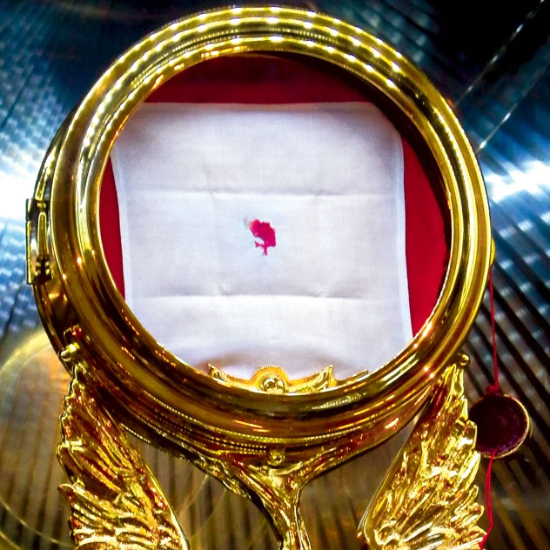
Short Summary: After a Eucharist fell during Mass and was placed in water, it remained intact and displayed red spots, leading to analysis that revealed it contained living heart tissue intertwined with the bread.
Details
Location: Sokólka, Poland
Year: 2008
Prayer: Lord, I wish to believe in you more fully. Grant me greater faith, a faith that is unreserved and penetrating of my thoughts and inclinations. Dispose me for clearer understanding of your great mysteries. In my humility, I ask for wisdom and sight, to see you within your works. Amen.
Verse: Jesus said to them, “I am the bread of life. Whoever comes to me will never be hungry, and whoever believes in me will never be thirsty. But I said to you that you have seen me and yet do not believe." -Jn 6:35-36
Full Story
During a Mass in Sokółka, Poland, a consecrated Eucharist accidentally fell to the floor. Following traditional practice, the priest placed the host in water to dissolve. However, after a week, Sister Julia Dubowska, the parish sacristan, noticed that the Eucharist had not fully dissolved. More remarkably, a bright red spot appeared in its center, resembling blood. The archbishop ordered an investigation, and the altered host was analyzed at the Medical University of Białystok by two prominent histopathologists, Prof. Maria Sobaniec-Lotowska and Prof. Stanislaw Sulkowski. Their findings were astounding. The red area of the host was identified as myocardial tissue, specifically heart muscle tissue from a living human being, showing clear signs of distress and near-death conditions. Under advanced optical and electron microscopes, the tissue revealed clear lesions characteristic of heart muscle cells that had undergone extreme stress. The analysis also noted the tissue had not undergone autolysis (the natural process of cell breakdown after death), which would typically occur within days under normal conditions. Remarkably, the tissue remained intact. Perhaps the most extraordinary finding was the seamless integration of the heart muscle fibers with the bread of the host. This phenomenon was declared scientifically inexplicable, and could not be replicated by any known natural or artificial process - ruling out any possibility of fraud. Further testing also revealed that the blood type present was AB, the same as in other documented Eucharistic miracles, such as the famous Eucharistic Miracle of Lanciano. This blood type is known as the universal recipient and has often been associated with these types of phenomena. The host, dried and fused to a corporal cloth, is now preserved and displayed in Sokółka, attracting pilgrims from around the world who come to venerate this miraculous event.
Related Miracles
-
Related Miracle 1
Related Miracle 2
Related Miracle 3
Related Miracle 4
Related Miracle 5
Related Miracle 6
Related Miracle 7